Key takeaways
- Microsoft Fabric and Azure Databricks are both powerful data platforms — with genuinely different strengths.
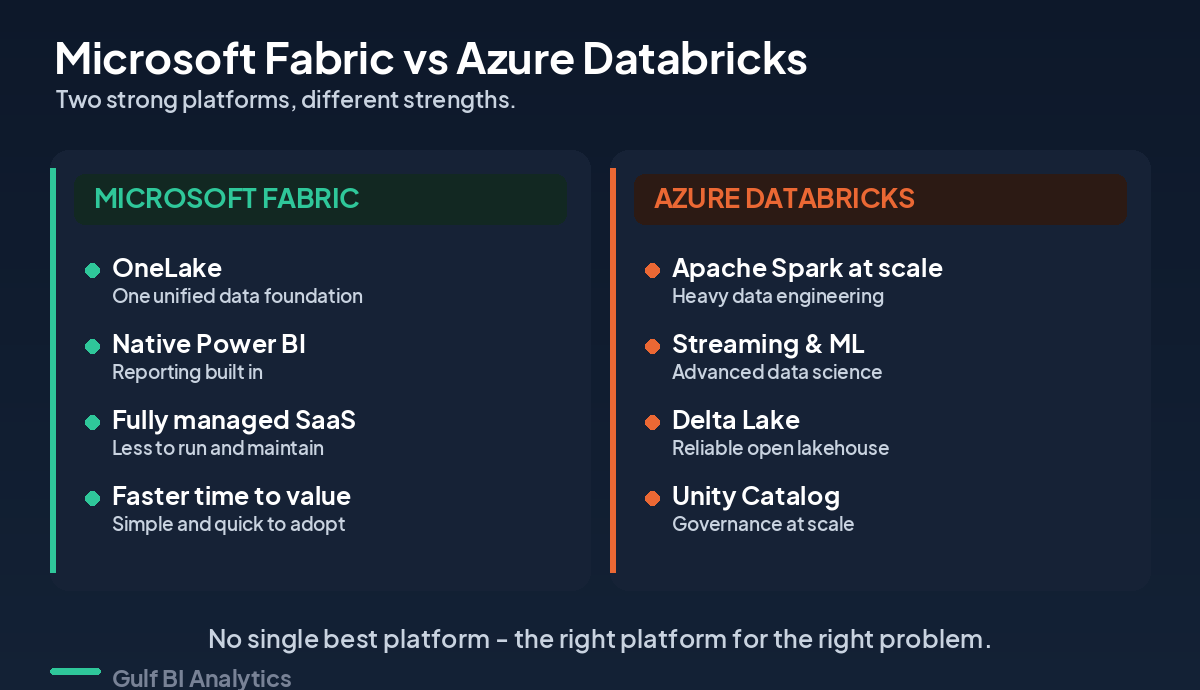
- Fabric is a unified, SaaS platform built for the Microsoft ecosystem, with OneLake and native Power BI — simple and fast to value.
- Databricks is a flexible, Spark-based platform built for complex data engineering, machine learning and streaming at scale.
- There is no single “best” — choose the platform that fits your problem, team and stack. Many organisations use both.
“Microsoft Fabric or Azure Databricks?” is one of the biggest data-platform questions of the moment. Both are excellent, and neither is a wrong choice — but they are built for different jobs. This is an honest comparison to help UAE businesses decide which fits, without the hype.
What is Microsoft Fabric?
Microsoft Fabric is a unified, software-as-a-service analytics platform that brings data integration, engineering, warehousing, real-time analytics and Power BI together on one data lake, OneLake. It is built for the Microsoft ecosystem and prized for being simple, managed and quick to deliver value. New to it? See our guide to what Microsoft Fabric is.
What is Azure Databricks?
Azure Databricks is a data and AI platform built around Apache Spark and the Delta Lake format. It is designed for large-scale data engineering, advanced machine learning and streaming, with fine-grained governance through Unity Catalog. It is powerful, flexible and code-first — and runs across multiple clouds, not just Azure.
Fabric vs Databricks at a glance
| Factor | Microsoft Fabric | Azure Databricks |
|---|---|---|
| Best for | BI and analytics on the Microsoft stack | Large-scale data engineering, ML and streaming |
| Data foundation | OneLake | Delta Lake |
| Power BI | Native and seamless | Connects, but less integrated |
| Ease of use | Simple, low-code friendly | Technical, code-first |
| Governance | Built in (OneLake, Purview) | Unity Catalog |
| Cloud | Azure and Microsoft 365 | Multi-cloud (Azure, AWS, GCP) |
| Team fit | Analysts and engineers | Data engineers and scientists |
When Microsoft Fabric fits
- You are a Microsoft 365 and Azure organisation and want tight integration.
- Power BI is central and you want reporting built in.
- You value a managed, low-maintenance platform over maximum control.
- Your team mixes analysts and engineers, and you want fast time to value.
When Azure Databricks fits
- You have heavy, complex data engineering or huge data volumes.
- Advanced machine learning and data science are core to what you do.
- You need real-time streaming pipelines at scale.
- Your team is code-first, or you operate across multiple clouds.
Can you use both?
Yes — and many organisations do. Both platforms build on open formats (Delta and Parquet), and Fabric’s OneLake can point at data managed by Databricks through shortcuts, without moving it. A common pattern is Databricks for heavy engineering and data science, with Fabric and Power BI for governed reporting and self-service analytics on top. They are not mutually exclusive.
The UAE context
Most businesses in Dubai and the UAE already run Microsoft 365 and Azure, which makes Fabric the pragmatic default for BI-led teams that want simplicity and speed. Databricks earns its place in data-intensive organisations with serious engineering and machine-learning needs. As the tagline goes: there is no single best platform — only the right platform for the right problem.
Not sure which fits your business?
We help UAE teams choose the right data platform and build on it properly. Gulf BI Analytics offers Microsoft Fabric consulting and senior-led Power BI consulting in Dubai, plus Microsoft Fabric training to upskill your team. Book a free consultation and we will give you a straight recommendation for your situation.
Planning a move to Fabric? Explore our Microsoft Fabric consulting in the UAE — strategy, adoption & architecture, migration and end-to-end implementation.
Frequently Asked Questions
Is Microsoft Fabric better than Azure Databricks?
Neither is strictly better. Fabric is a unified, managed platform built for the Microsoft ecosystem and BI. Databricks is a flexible, Spark-based platform for large-scale data engineering and machine learning. The right choice depends on your problem.
What is the main difference between Fabric and Databricks?
Fabric is a simple, unified SaaS platform with native Power BI and OneLake. Databricks is a powerful, code-first data and AI platform built on Apache Spark and Delta Lake, strong at engineering and ML at scale.
Can you use Microsoft Fabric and Databricks together?
Yes. Both use open formats like Delta, and Fabric OneLake can point at Databricks data through shortcuts. A common pattern is Databricks for engineering and Fabric with Power BI for governed reporting.
Which is easier to use?
Fabric is generally simpler and more low-code friendly, which suits analyst-heavy teams. Databricks is more technical and code-first, which suits data engineers and scientists.
Which should a UAE business choose?
For most UAE teams already on Microsoft 365 and Azure with a BI focus, Fabric is the pragmatic default. Databricks fits data-intensive organisations with heavy engineering and machine-learning needs.