Key takeaways
- AI (Copilot) is now part of everyday Power BI dashboard development.
- Microsoft Fabric consolidates the data stack on OneLake.
- Direct Lake enables fast, near-real-time reporting on large data.
- Translytical task flows turn dashboards into action.
- Every 2026 trend depends on a clean, governed data model.
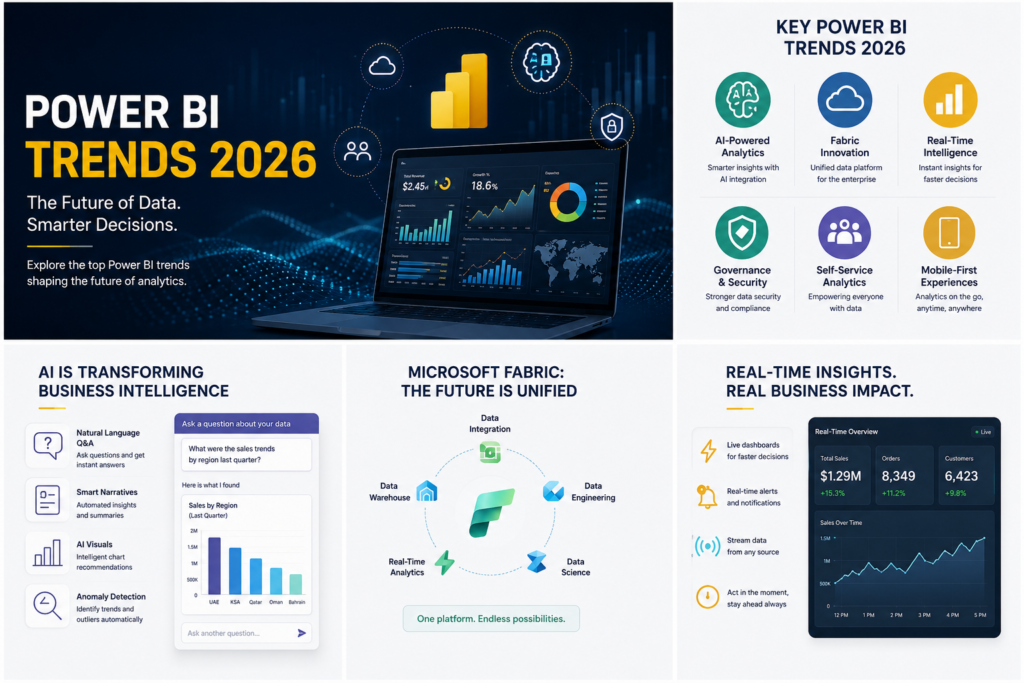
Business intelligence is moving faster than at any point in the last decade. Going into 2026, three forces are reshaping how organisations build and consume Power BI: generative AI through Copilot, the consolidation of the data stack into Microsoft Fabric, and a shift from passive dashboards to reports that trigger real business actions. Here are the trends UAE finance and operations teams should plan for this year.
1. Copilot becomes part of everyday dashboard development
Power BI Copilot has matured from a novelty into a genuine productivity tool, and teams are now going further by automating Power BI reports with MCP. It can draft DAX measures, summarise a report in plain language, and answer ad-hoc questions from business users who would never write a formula. For teams in Dubai and the wider UAE, this lowers the barrier to self-service analytics — but it also raises the bar on data modelling. Copilot is only as good as the semantic model underneath it, which makes a clean, governed model more important than ever.
2. Microsoft Fabric consolidates the data stack
Microsoft Fabric brings data engineering, warehousing, real-time analytics and Power BI together on a single data lake called OneLake. Instead of stitching together separate tools and moving data between them, organisations get one platform with one copy of the data. In 2026, expect more UAE businesses to evaluate Fabric as their central analytics platform, especially those already invested in Microsoft 365 and Azure. Microsoft Fabric consulting is quickly becoming one of the most requested services in the region.
3. Direct Lake makes large-scale reporting fast
One of Fabric’s most important features is Direct Lake, which lets Power BI read data straight from OneLake without importing it or waiting for scheduled refreshes. The result is near-real-time reporting with import-level performance, even on very large datasets. For finance teams tired of slow refreshes and stale numbers, this is a meaningful change.
4. Translytical task flows turn insight into action
Historically, a dashboard told you what happened and then you left Power BI to do something about it. Translytical task flows let users write data back and trigger actions directly from a report — approving a budget, updating a forecast, or flagging an exception — without leaving the dashboard. This blurs the line between analytics and operational systems and is one of the most exciting developments of the year.
5. Governance and AI-readiness reach the boardroom
As AI features touch more of the reporting stack, data governance stops being an IT detail and becomes a board-level topic. Row-level security, certified datasets and clear data ownership are prerequisites for trusting AI-generated answers. Organisations that invested in a governed Power BI foundation will be the ones that adopt AI safely; those that did not will spend 2026 catching up.
What this means for UAE businesses
The common thread across every 2026 trend is the same: AI, Fabric and task flows all depend on a well-designed, governed data model. The organisations that benefit most will be those that treat their semantic model as an asset, not an afterthought.
Plan your 2026 BI roadmap with Gulf BI Analytics
Gulf BI Analytics is a senior-led Power BI consultancy in Dubai helping finance and operations teams across the UAE adopt Copilot, Microsoft Fabric and modern reporting the right way. Book a free consultation to map your roadmap for the year ahead.